
At a Glance
Choose Self-compacting concrete for:
- Small pours, upper floors, complex spaces and constrained sites.
- Projects in residential or healthcare settings, to minimise disruption.
- Floors that will not remain exposed and will be covered by another material.
- Projects operating under tight scheduling, where simplicity and speed are important.
Choose Power-floated concrete for:
- Large, open areas, simple spaces and ground floors.
- Commercial sites where noise and disruption are not a concern.
- Concrete floors that will remain exposed.
- Surfaces that need to be as durable and dense as possible.



What is self-compacting concrete?
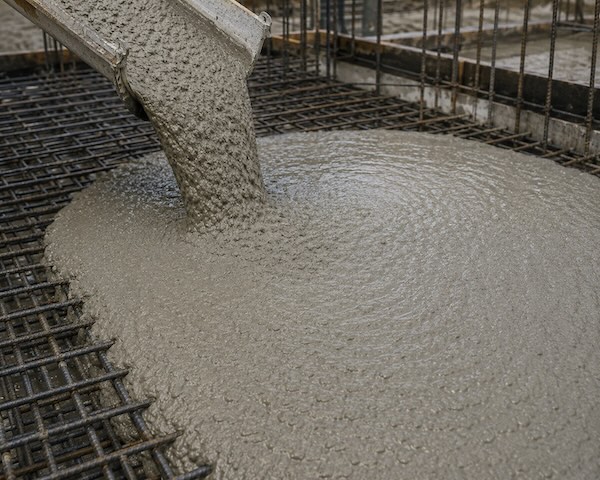
Self-compacting concrete (SCC) is a highly fluid concrete that is pumped into position and flows around and into complex structures. It moves easily into place without requiring as much physical handling, raking or shovelling as other types of concrete. The highly fluid nature of the concrete means it can also be worked quickly and efficiently with a lightweight dapple bar to release air bubbles and break surface tension, greatly reducing or eliminating the need for mechanical vibration. SCC concrete is set to level using laser equipment, ensuring a uniform floor thickness, a perfectly level surface and a pristine finish.
While the consistency of traditional concrete is assessed using a Slump Test, SCC concrete is too fluid to be tested by this method. Instead, SCC is assessed using a Slump Flow Test, which measures the extent to which the concrete flows or spreads on release. Depending on the product specifications, the concrete can be poured around either steel-mesh reinforcement grids or macro synthetic fibres.
The most common and well-known self-compacting concrete products include EasyFlow, Agilia and Tarmac’s Topflow.
What is power floated concrete?
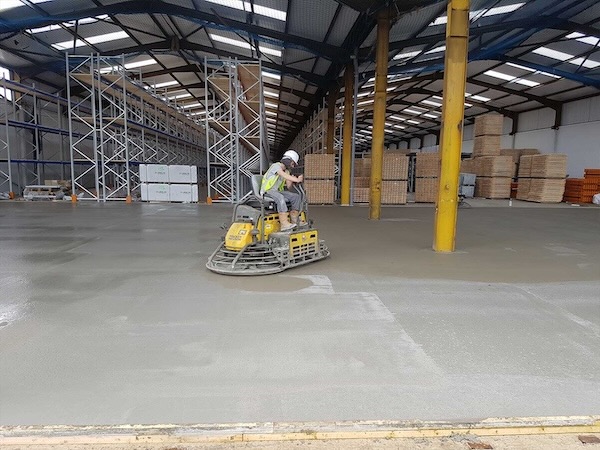
Power-floated concrete is a durable, dense concrete surface made by pouring standard concrete and then mechanically finishing it with a power float once the concrete has hardened enough to support the machine’s weight. This typically means power floating occurs 6 to 8 hours after pouring, requiring the site to remain open and site employees to continue working through the evening and into the night.
Power floats are pieces of heavy machinery equipped with rotating pans and blades that compact the concrete, expel air pockets, and seal small cracks to achieve a smooth, dense finish. The blade angle on power floats can be adjusted to achieve either a matte or high sheen surface. Running on petrol or diesel, they generate considerable noise, which can be problematic in areas where disruption needs to be minimised.
Power-floated concrete floors are widely regarded as the industry standard for large, open ground-floor slabs where site accessibility allows the use of heavy machinery and a larger workforce. They are also a popular option for exposed finishes – where the concrete will be the final floor surface and not covered by vinyl, carpet, tiles or other materials.
Why SCC is often better on hollowcore slabs and precast floors
The simplicity and versatility of self-compacting concrete make it particularly well-suited to sites and projects where accessibility, project scheduling or noise are concerns. Consequently, SCC is often the preferred choice when project managers require a concrete surface in awkward or spatially constrained sites (e.g., upper floors), are running to a tightly scheduled construction programme, or need to minimise disruption.
Accessibility and logistics
Upper floors pose a significant challenge for power float machinery. Typically weighing around a quarter of a tonne, the machines have to be lifted onto the wet concrete and require access at the start of the slab. This simply isn’t possible on many upper floors or complex, constrained sites. In these instances, SCC concrete is the more practical choice, as it can be poured and finished without heavy machinery.
Noise and disruption
With power-floated concrete flooring, the need to finish the concrete 6 to 8 hours after pouring often results in finishing late at night. To facilitate this, additional lighting is required, inflating project costs. Power floats are noisy pieces of equipment, making them ill-suited to sites where such disruption is likely to cause problems, such as residential areas or hospitals. The petrol fumes emitted by the power floats also affect local air quality and can lead to further objections.
This makes self-compacting concrete the preferred choice when you want to avoid sites staying open late and keep disruption to a minimum.
Staying on schedule
With SCC, the pour, level and dapple process ensures it is quicker, less labour-intensive, and less reliant on machinery. Whereas power-floated concrete requires extended site access, many moving parts, and an additional power-floated stage, all of which increase the likelihood of delays, overruns, and missed project deadlines, SCC’s simplicity ensures it’s the superior option if you’re working to tight scheduling and cannot afford hold-ups.
Process vs finish
Self-compacting concrete’s cleaner installation process requires less labour, time and logistical complexity. It generates less noise and fewer petrol fumes, minimising disruption, and it simplifies pouring in small and inaccessible spaces. In many projects, these operational benefits will significantly outweigh the need for an ultra-durable, exposed, power-floated floor surface. This is where SCC is most advantageous and the practical choice.
The advantages of power floated concrete
For straightforward pours, it is hard-wearing, durable, and economical
Power-floated concrete is usually the preferred choice when the concrete will remain uncovered and serve as the final surface. Similarly, it’s regularly selected for large, open ground-floor spaces which pose few logistical and accessibility challenges. As such, it’s typically used for warehouses, industrial buildings and some waste management facilities.
This is largely because power-floated concrete has genuine performance advantages over SCC. It results in a harder-wearing surface and a highly durable, low-maintenance and aesthetically pleasing finish. Power floating helps to create a denser, less porous surface that is resistant to chemical spills, while the smooth finish means it’s relatively easy to clean. In many cases, power-floated concrete will also be more economical for large, simple spaces.
Choosing between SCC and power-floated concrete?
We can advise on the most practical screed method based on your site constraints.
Tolerances and floor finishes
When installed correctly, both self-compacting concrete and power-floated concrete can be finished to meet BS8204 SR2 tolerances typically used in residential and commercial projects (a maximum deviation of ±5 mm under a 2-metre straightedge). In this respect, both meet industry standards.
When it comes to finishes, asking the two following questions may help inform your decision:
- Will the concrete be covered with a secondary floor finish?
- Do you require the most durable finish possible?
In most residential buildings, hospitals, and schools, vinyl, carpet, and similar flooring finishes will be applied over concrete. Additionally, an ultra-durable surface isn’t necessary in these environments. In these cases, SCC will meet performance requirements while being significantly easier and quicker to pour.
In industrial and some commercial settings, the concrete layer will be left exposed for easier maintenance and a durable finish that can withstand the stress of heavy machinery. In these cases, power-floated concrete is the optimal choice.
Cost, programme and buildability
Self-compacting concrete, as a construction material, is typically more expensive per square metre than power-floated concrete. However, power-floated concrete has higher associated costs. It requires more labour and machinery, will usually necessitate extended working hours and out-of-hours pay, and increases operational complexity. These all drive up cost and need to be factored into planning, pricing and material selection.
On many projects, programme and process are at least as, if not more, important than headline material cost. While initial expenditure may be slightly lower with power-floating, those savings can quickly turn into additional spending if power floating proves challenging, results in delays, or requires significantly more labour and equipment.
In general, power-floating will be the more economical choice for large, open, ground-floor pours with no added complexity. However, SCC is often more cost-effective in smaller, awkward pours or when its ability to simplify application and logistics is commercially beneficial.
Comparison Table
| Criteria | Self-compacting concrete (SCC) | Power-floated concrete |
|---|---|---|
| Installation process | Pumped, self-levelling, minimal handling | Mechanically finished using power floats |
| Labour & machinery | Lower labour and minimal machinery | Higher labour and heavy machinery required |
| Site suitability | Ideal for upper floors, awkward and constrained spaces | Best for large, open, accessible ground floors |
| Noise & disruption | Quiet, low disruption, standard working hours | Noisy, disruptive, often requires late working |
| Programme & logistics | Faster, simpler, lower risk of delays | More complex with greater delay risk |
| Finish & appearance | Smooth finish typically covered by flooring | Dense, polished finish suitable for exposed surfaces |
| Durability & maintenance | Suitable for standard residential/commercial use | Highly durable, low-maintenance surface |
| Tolerances | Achieves BS8204 SR2 | Achieves BS8204 SR2 |
| Cost considerations | Higher material cost but often cheaper operationally on complex sites | Lower material cost but higher labour/equipment costs |
| Typical applications | Residential, healthcare, schools, precast floors | Warehouses, industrial and commercial floors |
| Main advantage | Accessibility, speed and simplicity | Durability and exposed finish quality |
| Main limitation | Less suitable for exposed heavy-duty floors | Less practical in constrained or inaccessible areas |
As with most construction materials, techniques and processes, it’s impossible to say that SCC is hands-down better than power-floated concrete or vice versa. It is entirely dependent on the project specifics and the site context.
Trent’s operational approach
At Trent, we specialise in providing professional concrete services for complex pours. Whereas most contractors hire a standard pump, we benefit from owning our own specialist line pumps and placing booms, enabling us to access hard-to-reach areas. Our unique setup means we’re able to separate pumps and booms and leave equipment on-site when necessary, giving us greater control over pours, ensuring we can work to the client’s desired programme, and affording us greater operational flexibility.
As a Constructionline Gold member and a certified Cyber Essentials Plus business, we satisfy tier-one contractor prequalification and compliance requirements. Our experience working in sensitive and high-security settings equips us with the expertise required for demanding projects, and our previous work in specialist environments, such as waste facilities, means we’re accustomed to delivering to exacting standards.
Specialised concrete solutions with Trent
Choosing the right concrete for a project requires decision-makers to consider the site conditions and accessibility, as well as project logistics and programme. The final finish and intended use will also play a pivotal role in determining which concrete is best-suited.
SCC is often the preferred choice for hollowcore and precast flooring projects that involve small or upper floor pours and complex or awkward spaces. Simplified installation and minimal disruption also mean it’s well-suited to tightly scheduled programmes and sites where noise and disturbance are a consideration.
On the other hand, power-floated concrete is the surface of choice for large, open spaces where hard-wearing, exposed flooring is required.
If you require assistance selecting the appropriate concrete for your site or want to discuss your project with a highly experienced concrete specialist, contact the Trent team today.