





Precast concrete slabs and hollowcore slabs are a standard method used for concrete flooring across a wide range of commercial buildings.
The hollowcore or precast concrete slab forms the structural floor. We then install a structural topping layer of concrete screed over the top to bring the floor to level and provide a surface suitable for final floor finishes.
Different methods of installation and types of screed are available, depending on the specific site constraints. We specialise in those ‘awkward’ or constrained sites where a bit more technical know-how is required for the project.
How Site Constraints Determine Screed Installation Method
Many construction sites come with inherent constraints, such as:
- Built-up or residential areas
- Restricted access to upper floors
- Limitations on working hours
- Project time constraints etc
All of these factors contribute to project complexity. The team at Trent can assess these constraints early and plan the installation method around them.
For precast concrete slabs we can offer both Power-Floated Concrete and Self-Compacting Concrete toppings, and we often recommend self-compacting concrete where access, time, or working conditions make traditional power floating impractical.
Our Preferred Approach for Constrained Sites
Self-Compacting Concrete on Precast Planks
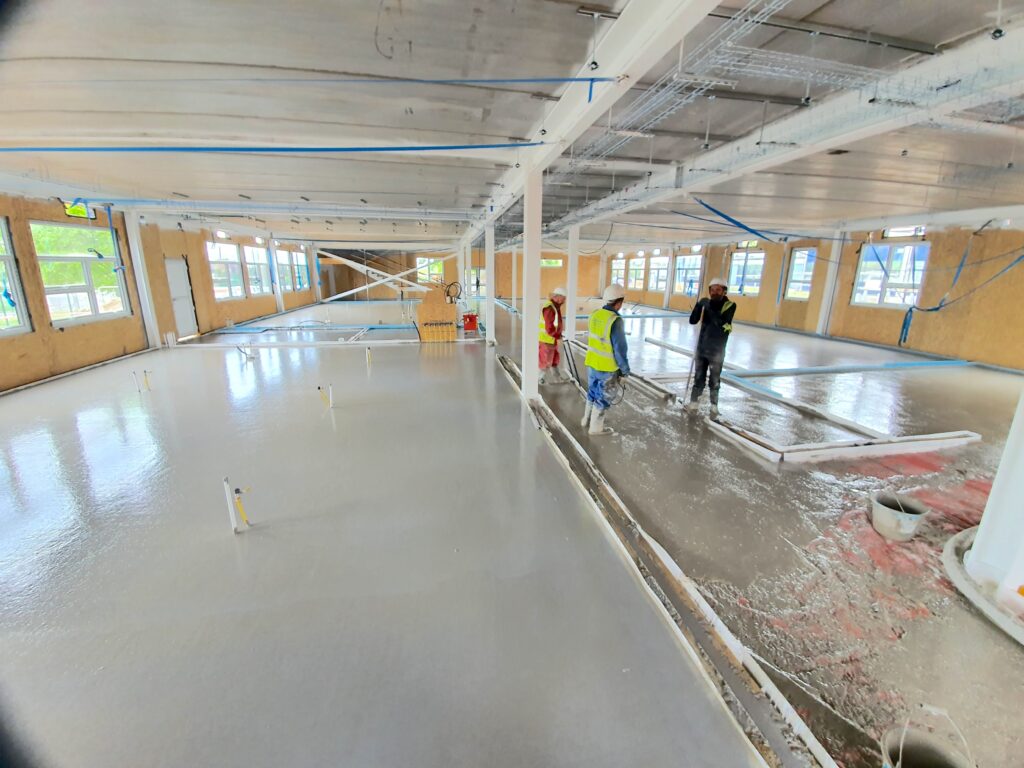
On these more complex types of projects we often recommend Self-Compacting Concrete as the topping on the precast planks. This is because Self-Compacting Concrete can placed and finished in a single operation.
Because the material is more fluid, it settles into place without the need for a secondary stage of power-floating or intensive manual working. The slab is placed, finished and completed in one pass.
This process much more straightforward:
- No need to lift heavy power-floating machines up and onto the wet slab
- No need for late working or overnight operations.
- Less people moving across wet concrete.
- Less issues around noise, lighting and site access
- No fumes from petrol-powered equipment operating in enclosed areas.
In simple terms, Self-Compacting Concrete removes the complex second operation, which is often what creates the difficulty on these jobs.
Working with precast or hollowcore slabs?
We can advise on the most practical screed method based on your site constraints.
Finish and Tolerances
In terms of finish, both methods – Power-Floated and Self-Compacting Concrete – are capable of achieving the required tolerances when carried out correctly. For most projects using a precast concrete floor, the target is typically SR2, which is suitable for floors receiving secondary finishes such as vinyl or carpet.
Power-floated and Self-Compacting processes both achieve these tolerances consistently and provide a clean, level surface for follow-on trades.
Equipment and Delivery Capability
We operate our own concrete line pumps and placing booms, giving us full control over how the concrete is moved and placed.
On constrained site projects, the pump and boom can be separated and positioned where access is limited, rather than relying on larger, lorry-mounted equipment. This allows concrete to be placed into areas that would otherwise be difficult to reach, without relying on third-party setup. Equipment can be left in position and used as the programme requires.
This is a huge advantage when access and programme timescales are tight.