





No Need for Late Working or Power-Floating
Avoiding late working is a major advantage, especially in urban environments such as schools, hospitals or built-up residential areas, where out-of-hours operations are undesirable.
Our method also avoids the practical problems of getting power-floating machinery, which often weigh ¼ tonne each, and operatives onto the slab after pouring. This can reduce the need for lighting and ventilation, as well as the logistics of moving machines across wet concrete and physically lifting equipment onto elevated floors.
All of this can greatly simplify your logistics and significantly reduce construction time.
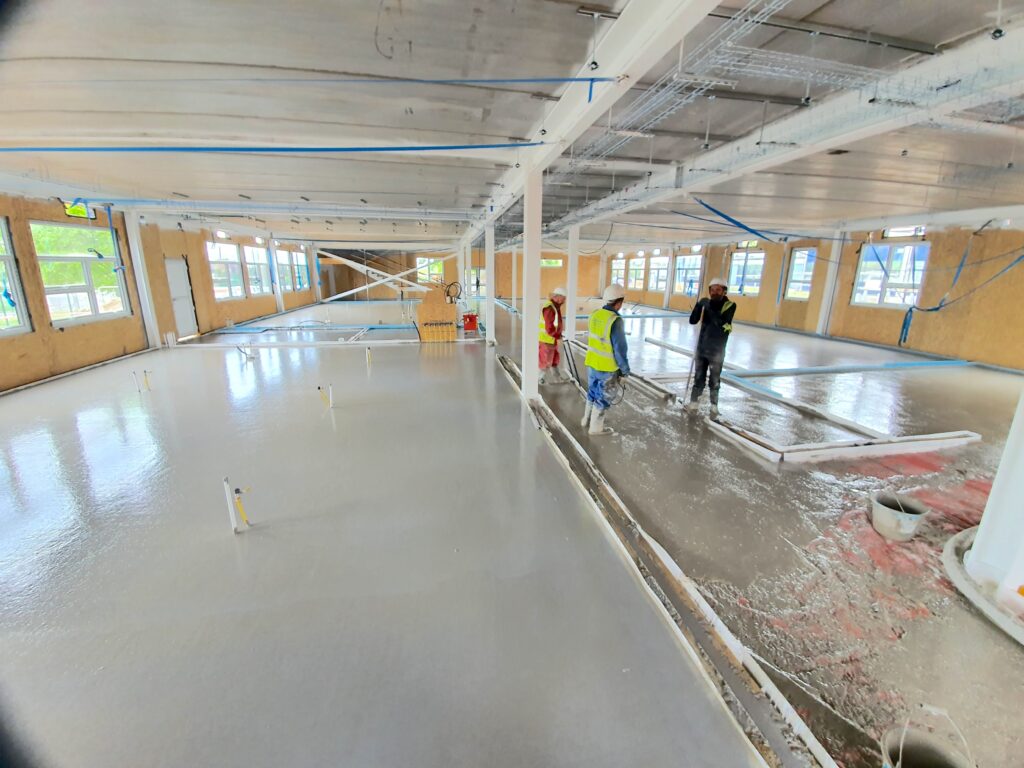
Where self-compacting concrete works best
Self-compacting concrete works particularly well on projects that include any of the following constraints:
- Schools and hospitals
- Built-up or residential areas
- Confined or enclosed spaces (fume issues)
- Multi-storey or elevated slabs
- Sites with restricted or awkward access
- Any project where late-night working is not acceptable
We regularly advise contractors and project teams at an early stage where standard methods are likely to create practical challenges on site.
Not sure if self-compacting concrete is suitable for your project?
Send your drawings or specification and we will advise on the most practical approach.
Installation of self-compacting concrete
The installation method for self-compacting concrete is similar to standard pumped concrete. The concrete is pumped into place in the same way, but instead of vibrating the concrete to level it, the more fluid self-compacting mix is levelled using a dappling bar to create a wave and bring it to level.
After that, no further finishing operation is usually needed apart from curing.
In most applications, these slabs will receive a final floor finish (such as vinyl or carpet tiles), meaning a power-floated surface is not required.
Self-compacting concrete can achieve the same surface regularity tolerances (typically SR2 to BS8204 which is +/- 5mm over a 2-metre straightedge) as traditional power-floated slabs when installed correctly.
Cost vs benefits of self-compacting concrete
Overall the net cost of using self-compacting concrete is similar to using power-floated concrete. The material cost for SCC can be higher per square metre, but this is balanced out by lower costs for labour and logistics.
Self-compacting Concrete is often more economical on smaller projects, or on sites with any of the constraints listed above. This is because significant savings are made on labour and process costs – ie removing the power-floating operation.
The result is a simpler, more controlled installation with fewer risks, fewer constraints, and less disruption to the surrounding environment.